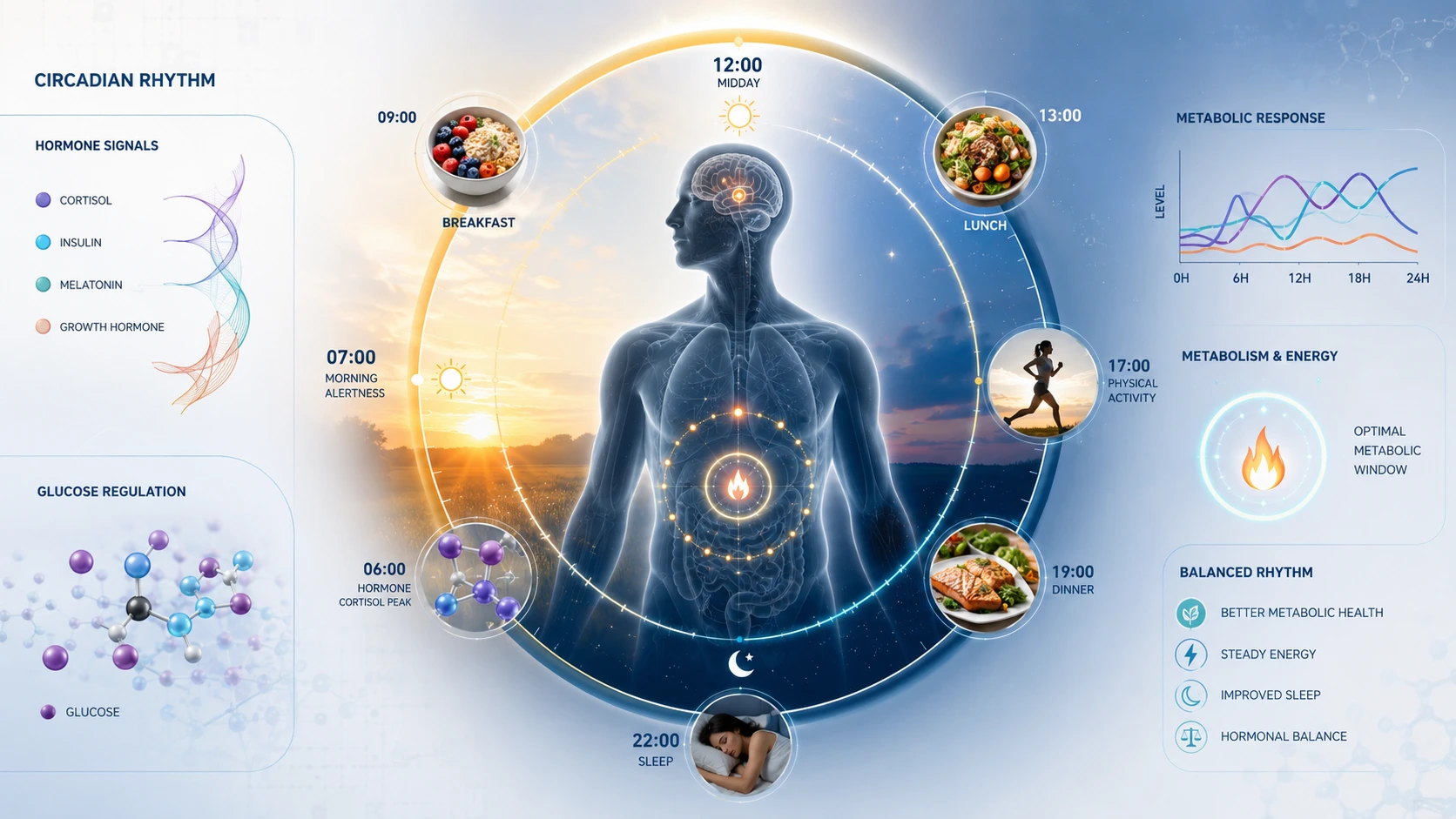
Have you ever noticed that your body seems to know when it is time to wake up, feel hungry, become active, or prepare for sleep? That timing is not simply a matter of habit. Your body contains an internal biological timing system called the circadian rhythm, which follows a cycle of approximately 24 hours and helps coordinate sleep, hormones, digestion, metabolism, and many other physiological processes. An increasingly important area of research is circadian rhythm and meal timing, which looks at how the timing of food may interact with the body’s internal clock and influence metabolic health.
The idea is simple but fascinating: your body does not necessarily respond to food in exactly the same way at every hour of the day. Light, darkness, sleep, physical activity, and food all provide signals that help synchronize different biological clocks. The National Heart, Lung, and Blood Institute explains that circadian clocks exist throughout the body and are strongly influenced by environmental cues such as light and darkness. :contentReference[oaicite:1]{index=1}
This does not mean that there is one perfect hour when everyone should eat, nor does it mean that eating after a particular time automatically makes food unhealthy. The science is much more nuanced. Researchers are studying whether consistent meal timing, adequate sleep, daylight exposure, and a stable daily routine can work together to support healthy metabolic function.
7 Key Facts About Circadian Rhythm and Meal Timing
- Circadian rhythms follow cycles of approximately 24 hours.
- The brain’s central clock is strongly influenced by light and darkness.
- Other circadian clocks exist throughout the body, including tissues involved in metabolism.
- Food timing can act as an environmental signal for metabolic tissues.
- Sleep, activity, light exposure, and meal timing can influence the body’s daily rhythm.
- Human studies of time-restricted eating have produced mixed results.
- There is currently no single meal schedule that is proven to be ideal for everyone.
What Is the Circadian Rhythm?
The circadian rhythm is the body’s internal timing system. The term describes biological processes that repeat on a cycle of roughly 24 hours. According to the National Heart, Lung, and Blood Institute, circadian clocks influence every cell, tissue, and organ in the body. These clocks help coordinate when you feel alert, when you become sleepy, and how different physiological systems operate throughout the day. :contentReference[oaicite:2]{index=2}
Light and darkness are among the strongest signals controlling the central circadian clock. When your eyes detect daylight, signals reach an area of the brain called the suprachiasmatic nucleus, or SCN. This central clock then helps synchronize other biological processes. Darkness provides another important signal, helping the body transition toward its normal nighttime state. :contentReference[oaicite:3]{index=3}
Your circadian rhythm is not identical to everyone else’s. Some people naturally feel more alert earlier in the morning, while others tend to become more alert later in the day. The NHLBI notes that teenagers commonly experience a shift toward later sleep timing, which is one reason adolescents may naturally prefer later bedtimes than younger children or many adults. :contentReference[oaicite:4]{index=4}
How Your Body Clock Works
Think of the circadian system as a biological orchestra. The central clock acts like a conductor, while clocks in different tissues help individual organs keep their own schedules. For the body to work efficiently, these different systems need signals that generally agree with one another. Light exposure, sleep, physical activity, and food are among the environmental signals that can influence this timing system.
The relationship between circadian rhythm and meal timing becomes particularly interesting because food can provide timing information to tissues involved in metabolism. Your liver, digestive system, muscles, and other tissues respond to nutrients, and researchers are studying whether the timing of those nutrients affects the synchronization of peripheral biological clocks.
This does not mean that one meal can reset your entire body clock. Circadian biology is influenced by multiple signals working together. A regular sleep schedule, appropriate exposure to daylight, daily activity, and a consistent eating routine may provide a more coherent set of signals than focusing on one isolated behavior.
Why Meal Timing Matters
Nutrition research has traditionally focused heavily on what people eat. Chrononutrition adds another question: when do they eat? Researchers are investigating whether the timing and regularity of meals influence glucose regulation, hormone activity, energy metabolism, and other physiological processes.
The timing of meals may be especially relevant when it repeatedly conflicts with a person’s normal sleep-wake cycle. For example, someone who stays awake throughout the night and eats several meals during their biological nighttime is exposed to a very different pattern from someone who eats mainly during the daytime and sleeps at night.
However, meal timing should not be treated as a replacement for good nutrition. A balanced diet, adequate nutrients, sufficient sleep, physical activity, and individual medical needs remain important. The emerging evidence suggests that timing may be another piece of the puzzle rather than the entire puzzle.
Consistency May Matter More Than a Perfect Clock Time
One useful way to think about meal timing is consistency. The NHLBI notes that maintaining a regular routine can be helpful for circadian rhythm health, including keeping a regular meal schedule, particularly for people with irregular sleep schedules or shift work. :contentReference[oaicite:5]{index=5}
Circadian Rhythm and Metabolism
Metabolism changes across the day rather than operating at exactly the same level from morning until midnight. Research in chronobiology suggests that processes involving glucose, insulin, lipid metabolism, hormones, and energy use can display daily patterns. This is one reason scientists are investigating the relationship between circadian rhythm and meal timing.
The important distinction is that biological timing is not the same as a simple “food after 8 p.m. is bad” rule. Your actual biological schedule depends on when you normally sleep and wake, your exposure to light, your activity, and many other factors. A person who works overnight may have a very different biological schedule from someone who sleeps during conventional nighttime hours.
Researchers are therefore interested in the concept of circadian alignment. In simple terms, this means that important behaviors such as sleeping, eating, and activity occur in a pattern that is reasonably synchronized with the body’s internal clock and environmental signals.
Meal Timing, Blood Sugar, and Insulin
Blood glucose regulation is one of the most closely studied areas of meal timing research. Insulin helps the body regulate glucose, and insulin sensitivity can vary according to biological timing. Researchers are investigating whether eating at different points in the circadian cycle changes the body’s response to nutrients.
Nighttime schedules are particularly interesting because they can combine several factors at once: disrupted sleep, artificial light exposure, unusual meal timing, and reduced daytime activity. This makes it difficult to determine whether one factor is responsible for a metabolic change. Controlled human studies are therefore important for separating these influences.
Important Point
Meal timing can influence metabolic responses, but timing is only one part of metabolic health. Food quality, total nutrition, sleep, activity, genetics, medications, and existing health conditions can all matter.
What About Late-Night Eating?
Late-night eating receives a lot of attention online, but the scientific reality is more complicated than many headlines suggest. Eating late once in a while is not automatically harmful. Researchers are more interested in repeated patterns of eating during the biological night, especially when those patterns occur alongside irregular sleep or night-shift work.
The NHLBI explains that circadian disruption can occur when the body’s sleep-wake cycle becomes out of sync with environmental signals. Shift work and jet lag are examples of situations that can create this mismatch. :contentReference[oaicite:6]{index=6}
This is why the question should not simply be “What time did you eat?” A better question is “How does your eating schedule relate to your sleep-wake schedule?” That broader perspective is much closer to how researchers study circadian rhythm and meal timing.
Sleep and Meal Timing Work Together
Sleep is one of the most important components of circadian health. The body’s internal clocks help determine when you feel sleepy and awake, while sleep itself influences many physiological processes. The NHLBI explains that insufficient or poor-quality sleep can affect metabolism as well as thinking, concentration, and overall health. :contentReference[oaicite:7]{index=7}
This creates an important connection between sleep and meal timing. Staying awake late can provide more opportunities to eat, while eating very late may happen alongside exposure to bright artificial light and an irregular sleep schedule. Instead of treating these behaviors separately, researchers increasingly consider them parts of the same daily rhythm.
If you are interested in improving your daily rhythm, focusing on sleep consistency may be just as important as thinking about food timing. A regular bedtime and wake time, daytime light exposure, and a predictable daily routine can provide strong signals to your circadian system.
If you want to learn more about sleep habits, read our guide on how to improve sleep quality naturally.
What Is Chrononutrition?
Chrononutrition is the scientific study of the relationship between food timing, circadian rhythms, and health. Instead of asking only which foods a person consumes, chrononutrition also considers the timing, frequency, and regularity of eating.
Researchers are studying whether eating patterns interact with circadian clocks in the liver, digestive system, muscles, and other tissues. The field combines nutrition science with chronobiology, sleep science, physiology, and metabolic research.
The field is still developing. A 2024 PubMed-indexed editorial described chrononutrition as an area involving the interconnected concepts of chronotype, circadian rhythms, meal timing, metabolism, and personalized nutrition. :contentReference[oaicite:8]{index=8}
What Does Current Research Show?
Current research provides interesting evidence, but it does not support one universal eating schedule. Some clinical trials have reported improvements in certain metabolic measurements with time-restricted eating, while other randomized studies have found more limited effects. The differences may relate to study design, participant characteristics, food intake, sleep patterns, eating-window timing, and the duration of the intervention.
A major 2024 randomized controlled trial published in Annals of Internal Medicine included 108 adults with metabolic syndrome. Participants who followed an 8-to-10-hour eating pattern alongside standard nutritional guidance experienced modest improvements in hemoglobin A1C and reductions in body weight, BMI, and trunk fat after three months. The NIH emphasized that longer-term research is needed to determine the benefits and drawbacks of this approach. :contentReference[oaicite:9]{index=9}
Other trials demonstrate why caution is important. A randomized clinical trial published in JAMA Internal Medicine evaluated time-restricted eating in adults with overweight or obesity and found that the approach did not produce significantly greater weight loss than consistent meal timing. :contentReference[oaicite:10]{index=10}
Taken together, these findings suggest that circadian rhythm and meal timing is a legitimate area of scientific investigation, but the evidence should not be turned into exaggerated promises. More research is needed to understand which people may benefit, what timing patterns are most appropriate, and what the long-term effects may be.
Key Research Statistics on Meal Timing
In the 2024 NIH-highlighted trial, the time-restricted eating group showed approximately 3% to 4% reductions in weight, BMI, and trunk fat over three months, alongside a modest improvement in hemoglobin A1C. These results were observed in adults with metabolic syndrome and should not be interpreted as proof that the same approach is appropriate for everyone. :contentReference[oaicite:11]{index=11}
The study authors and NIH both emphasize the need for longer and larger clinical trials. This is an important distinction when interpreting health statistics: a short-term result in a specific adult population does not automatically become a universal recommendation.
Meal Timing: What We Know vs. What We Don’t
| Research Question | What Evidence Suggests | What Remains Unclear |
|---|---|---|
| Does circadian timing affect metabolism? | Yes, biological processes show daily patterns. | The size and clinical importance of these effects vary. |
| Does meal timing influence glucose regulation? | Some studies suggest it can. | The best timing for different people remains uncertain. |
| Is late-night eating always unhealthy? | Repeated nighttime eating may interact with circadian disruption. | Occasional late meals are not equivalent to chronic circadian disruption. |
| Is time-restricted eating universally beneficial? | Some adult trials show modest benefits. | Long-term effects and ideal schedules remain uncertain. |
| Does everyone have the same body clock? | No. Circadian timing varies between individuals. | Personalized recommendations are still being studied. |
Time-Restricted Eating Explained
Time-restricted eating is a research approach in which daily food intake occurs within a defined period. It is often discussed alongside intermittent fasting, although the terms can describe somewhat different approaches. Researchers are interested in whether limiting the daily eating period can influence metabolic health independently of other dietary factors.
The 2024 NIH-highlighted trial provides one useful example. Adults with metabolic syndrome were asked to follow an 8-to-10-hour eating period, with the timing adapted to their usual sleep and eating patterns. The eating period began at least one hour after waking and ended at least three hours before sleep. :contentReference[oaicite:12]{index=12}
Importantly, this was a clinical research protocol involving adults. It should not be interpreted as a recommendation for teenagers to restrict their eating window. Adolescence is a period of growth and development, and adequate nutrition is particularly important.
Why the Evidence Is Still Mixed
Different studies use different eating windows, populations, diets, sleep schedules, and study lengths. One recent randomized crossover study in women with overweight or obesity found no clinically meaningful differences in several cardiometabolic measures when comparing early and late time-restricted eating under controlled food intake conditions. :contentReference[oaicite:13]{index=13}
These differences are exactly why responsible health content should avoid presenting time-restricted eating as a guaranteed solution. The scientific question is still open, and future studies may clarify which aspects of meal timing matter most.
7 Practical Ways to Support a Healthy Body Clock
1. Keep Your Sleep Schedule Consistent
Going to bed and waking up at reasonably consistent times can provide your circadian system with predictable signals. Your sleep schedule does not need to be identical every single day, but large and repeated shifts can make your body clock harder to synchronize with your environment.
2. Get Daylight During the Day
Light is one of the strongest signals that regulates the central circadian clock. Spending time outdoors during daylight can provide a clear daytime signal to your body, while reducing unnecessary bright light exposure close to bedtime can help support the transition toward sleep. :contentReference[oaicite:14]{index=14}
3. Maintain a Predictable Meal Routine
A reasonably consistent eating schedule can provide regular timing cues. This does not mean you need to follow an extreme or rigid eating window. The goal is simply to avoid turning your daily eating pattern into a constantly changing schedule.
4. Avoid Obsessing Over Exact Meal Times
Your body is not controlled by a single number on a clock. A meal eaten at a slightly different time does not automatically change your health. Look at your overall routine rather than becoming anxious about occasional deviations.
5. Stay Physically Active
Physical activity provides another environmental signal to the body. Regular movement during the day can help establish a predictable active period and support overall health.
6. Prioritize Adequate Nutrition
Meal timing should never replace adequate nutrition. Your body needs sufficient energy, protein, vitamins, minerals, carbohydrates, fats, and fluids to function properly. The quality and nutritional adequacy of your diet remain fundamental.
7. Protect Your Sleep Environment
A dark, comfortable, quiet sleeping environment can make it easier to maintain a consistent sleep routine. Because sleep and circadian rhythm influence one another, improving your nighttime environment can support the larger daily rhythm.
Common Myths About Circadian Rhythm and Meal Timing
Myth 1: Eating After a Certain Hour Is Automatically Unhealthy
There is no universal clock time at which food suddenly becomes unhealthy. Biological timing depends on the individual’s sleep-wake schedule, daily routine, and other factors. Researchers are more interested in repeated patterns of circadian misalignment than in one isolated late meal.
Myth 2: Everyone Should Eat on the Same Schedule
People have different chronotypes, lifestyles, work schedules, and sleep patterns. The NHLBI notes that some people naturally wake earlier while others naturally stay up later, and adolescents often experience later sleep timing. :contentReference[oaicite:15]{index=15}
Myth 3: Fasting Is Required to Reset Your Body Clock
The circadian system receives signals from light, darkness, sleep, activity, and food. There is no established universal fasting routine that everyone needs in order to “reset” their body clock. If your sleep schedule is significantly disrupted, appropriate evaluation and treatment may be more useful than experimenting with restrictive eating.
Myth 4: Meal Timing Matters More Than Food Quality
Meal timing is not a substitute for a nutritious diet. What you eat remains an important part of health, and timing should be viewed as one potential component of a broader lifestyle pattern.
Who Should Be Careful With Restrictive Eating Patterns?
Restrictive eating patterns require particular caution during adolescence because the body is still growing and developing. Teenagers should not use fasting or restrictive diets to change body weight without guidance from a qualified healthcare professional and support from a parent or guardian.
Adults with diabetes, blood-sugar problems, certain medical conditions, or medications that affect glucose may also need professional guidance before changing meal timing. People who work overnight shifts may have additional circadian challenges that require individualized advice.
If you regularly experience severe daytime sleepiness, difficulty falling asleep, difficulty waking at the required time, or persistent disruption of your sleep schedule, speak with a healthcare professional. The NHLBI identifies excessive daytime sleepiness, difficulty sleeping, reduced alertness, and concentration problems among possible symptoms associated with circadian rhythm disorders. :contentReference[oaicite:16]{index=16}
What Scientists Still Don’t Know
One of the biggest unanswered questions is how much meal timing matters compared with other lifestyle factors. Researchers still need larger and longer clinical trials to determine which patterns produce meaningful long-term health benefits and which groups of people are most likely to respond.
Another challenge is individual variation. Two people may eat at exactly the same clock time while having completely different sleep schedules and circadian phases. A meal at 8 p.m. may be several hours before bedtime for one person but immediately before sleep for another.
Future research may therefore move toward more personalized recommendations based on chronotype, sleep timing, activity, metabolic health, and daily routines rather than relying on one universal clock-based rule.
Medical and Scientific Sources
The information in this article is based on research and educational resources from recognized medical and scientific organizations.
- National Heart, Lung, and Blood Institute — Your Sleep/Wake Cycle
- National Heart, Lung, and Blood Institute — Circadian Rhythm Disorders
- National Institutes of Health — Time-Restricted Eating for Metabolic Syndrome
- PubMed — Time-Restricted Eating in Adults With Metabolic Syndrome
- PubMed — Effects of Time-Restricted Eating on Weight Loss and Metabolic Parameters
- PubMed — Chrononutrition and Health
Conclusion
The science surrounding circadian rhythm and meal timing is developing rapidly. Your body contains a network of biological clocks that help coordinate sleep, hormones, digestion, metabolism, and daily activity. Light and darkness are powerful signals for the central clock, while food, activity, and sleep can provide additional timing information throughout the body. :contentReference[oaicite:17]{index=17}
Current research suggests that meal timing can interact with metabolic processes, but the evidence does not support a universal schedule that everyone should follow. Some adult clinical trials have reported modest metabolic benefits from time-restricted eating, while other randomized research has found more limited effects. Longer and larger studies are still needed.
The most practical takeaway is simple: your daily rhythm matters. A reasonably consistent sleep schedule, daytime light exposure, regular physical activity, adequate nutrition, and a predictable eating routine can all support a healthy lifestyle without requiring extreme diets or rigid fasting rules.
Rather than obsessing over one specific hour, look at the bigger picture. Your body works as a connected system, and healthy habits are most useful when they fit naturally into your daily life.
Frequently Asked Questions
1. What is circadian rhythm and meal timing?
Circadian rhythm and meal timing describes the relationship between the body’s approximately 24-hour biological clock and when food is consumed. Researchers study whether the timing and regularity of meals interact with circadian rhythms and metabolic processes.
2. Can meal timing affect metabolism?
Research suggests that meal timing can influence certain metabolic responses, including glucose regulation. However, the effects vary between people and depend on factors such as sleep, food intake, physical activity, and individual biology.
3. Is eating late at night always bad?
No. An occasional late meal does not automatically cause poor health. Researchers are more interested in repeated nighttime eating patterns, especially when they occur alongside disrupted sleep or night-shift schedules.
4. What is chrononutrition?
Chrononutrition is the study of how food timing interacts with circadian biology and health. It considers when people eat as well as what they eat and how their eating patterns interact with sleep and daily activity.
5. Does everyone have the same circadian rhythm?
No. People naturally differ in their preferred sleep and activity timing. Genetics, age, lifestyle, light exposure, work schedules, and other factors can influence circadian timing.
6. Does fasting reset the circadian rhythm?
There is no established universal fasting routine that everyone needs to follow to reset their body clock. Circadian rhythms respond to several signals, including light, darkness, sleep, activity, and food timing.
7. What is the most important habit for circadian health?
There is no single habit that works for everyone, but maintaining a reasonably consistent sleep-wake schedule, getting daytime light exposure, staying active, and following a regular daily routine can provide useful signals for the circadian system.