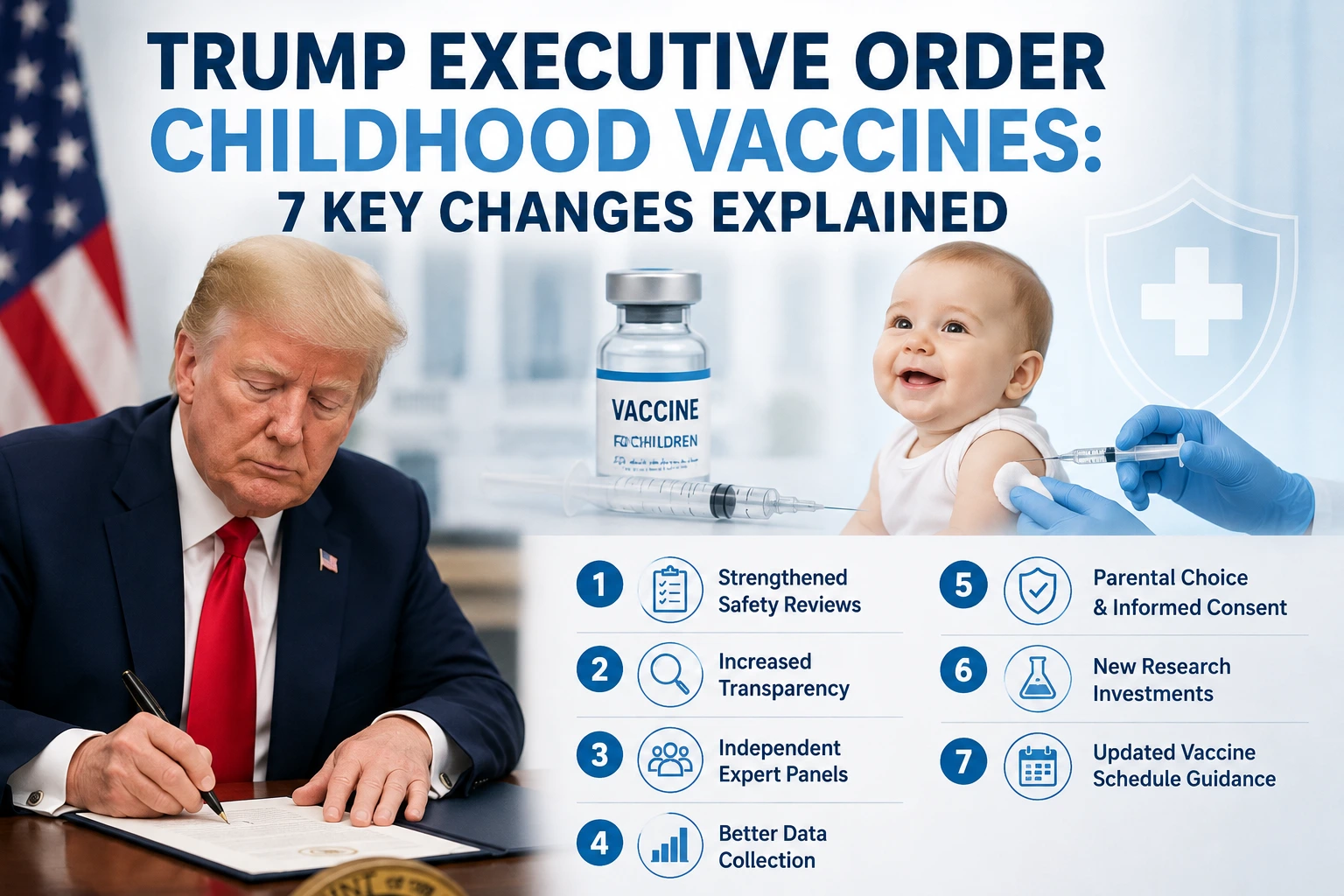
Trump executive order childhood vaccines is now a major U.S. health-policy story after President Donald Trump signed a new executive order on August 10, 2026. The order directs the federal government toward a revised approach to childhood vaccine recommendations and includes provisions concerning how vaccines are administered.
The new policy has attracted attention because the administration says it is establishing what it calls “gold standard” childhood vaccine recommendations. Reuters reports that the administration is recognizing recommendations for 11 core childhood inoculations, while the White House order also calls for vaccines to be administered individually rather than in combination when possible. The policy specifically addresses the measles, mumps, and rubella vaccine, commonly known as MMR.
The Trump executive order childhood vaccines debate is bigger than one vaccine or one political announcement. It involves federal recommendations, state vaccination requirements, healthcare providers, vaccine availability, and scientific evidence. This guide explains what happened, what the order says, what may change, and what parents should understand as the policy develops.
Trump Executive Order Childhood Vaccines: Quick Facts
- Date: August 10, 2026.
- Policy focus: Revising U.S. childhood vaccine recommendations.
- Core recommendations: The administration says it is recognizing 11 core childhood inoculations.
- MMR: The order calls for measles, mumps, and rubella vaccination to be administered separately when individual products are available.
- Combination vaccines: The order encourages individual administration of childhood vaccines where possible.
- State laws: Federal recommendations are different from state school-vaccine requirements.
- Important: The policy does not mean every child’s vaccination plan automatically changes overnight.
Trump Executive Order Childhood Vaccines: What Happened on August 10, 2026?
President Donald Trump signed a new executive order on August 10, 2026, directing federal agencies toward changes in U.S. childhood vaccine recommendations. The White House describes the policy as an effort to establish “gold standard” recommendations for American children. The official order is available through the White House.
One of the most important parts of the announcement concerns how childhood vaccines are administered. The administration says vaccines should generally be given individually rather than in combination when separate products are available. The MMR vaccine has received particular attention because the order calls for its measles, mumps, and rubella components to be administered separately when individual vaccines are available.
Reuters reported that the administration is recognizing recommendations for 11 core childhood inoculations as part of the new policy direction. That makes the August 10 announcement broader than a simple change to one vaccine. It represents another step in the administration’s effort to reshape federal childhood immunization policy.
What Does the Trump Executive Order Say?
The executive order directs federal agencies to pursue revised childhood vaccine recommendations and implementation steps. According to the White House, the policy is intended to recognize a “gold standard” approach and provide greater flexibility around childhood vaccination. The administration also wants federal recommendations to reflect its revised approach to the childhood immunization schedule.
The exact practical effect depends on how federal agencies implement the order. An executive order can direct federal departments and agencies, but it does not automatically rewrite every state law or determine every medical decision made by a pediatrician.
That distinction is essential when reading headlines about the Trump executive order childhood vaccines. A national policy announcement can influence recommendations and federal programs without instantly creating identical vaccination rules in all 50 states.
What Are the 11 Core Childhood Vaccines?
One of the most significant developments in today’s announcement is the administration’s recognition of 11 core childhood inoculations. Reuters reported that the administration is identifying 11 core vaccines within the revised federal framework. This represents a narrower federal recommendation framework than the broader childhood schedule that has historically included protection against a larger range of diseases.
It is important not to interpret the number “11” as meaning that every child will necessarily receive only 11 injections or that every vaccine outside the core list has suddenly become unavailable. Vaccination decisions can depend on age, medical history, travel, exposure risk, outbreaks, and other circumstances.
Families should therefore look at the current official recommendations that apply to their child’s age and circumstances rather than relying on a simplified list circulating on social media. The CDC child and adolescent immunization schedule provides official information about childhood vaccination recommendations.
Childhood Vaccine Statistics and Why They Matter
The policy debate is taking place against a changing vaccination landscape. Vaccination coverage is closely monitored because lower coverage can make it harder for communities to maintain protection against highly contagious diseases. The issue is particularly important for diseases such as measles, where outbreaks can spread quickly among people who are not protected.
The numbers alone do not tell the whole story. The meaning of a vaccine recommendation depends on the disease being prevented, the age of the child, vaccine availability, effectiveness, safety information, and the level of disease circulation. For that reason, a responsible health article should present statistics alongside their context rather than using isolated numbers to make a medical argument.
Trump Executive Order Childhood Vaccines and the MMR Debate
The MMR vaccine is at the center of the current policy discussion because it protects against measles, mumps, and rubella. The administration’s August 10 order calls for these components to be administered separately when individual products are available.
The change has attracted attention because combination vaccines are designed to protect against multiple diseases through a single vaccination product. Separating the components can therefore change the number of injections or appointments involved, depending on which products are available.
Current CDC information continues to provide detailed recommendations for measles, mumps, and rubella vaccination. A 2026 CDC MMR recommendations summary explains vaccination considerations by age and situation. Families should use current official guidance rather than assuming that a political announcement alone answers an individual medical question.
You can review the CDC MMR vaccine recommendations for additional information.
Why Does the Order Favor Separate Vaccines?
The administration says that giving vaccines individually can increase flexibility and allow parents and healthcare professionals to make more specific decisions. This approach is part of the broader philosophy behind the new federal recommendations.
Critics have raised practical concerns. If several vaccines are given separately, families may need more injections or additional healthcare visits. More appointments can create logistical barriers for families who have limited transportation, work constraints, childcare responsibilities, or difficulty accessing healthcare.
The question is therefore not simply whether vaccines can technically be separated. It is also about how changes in administration could affect access, completion of vaccination schedules, healthcare workload, and population protection.
Does the Order Immediately Change Every Child’s Schedule?
No. The Trump executive order childhood vaccines policy should not be interpreted as an instruction for every family to immediately change a child’s vaccination schedule without consulting current guidance.
Federal recommendations, state laws, healthcare-provider guidance, and individual medical decisions are related but separate systems. An executive order can direct federal agencies while state governments continue to control many vaccination requirements connected to schools and childcare.
Important Distinction for Parents
A federal vaccine recommendation is not automatically the same thing as a state vaccination requirement.
If you are unsure what applies to your child, check your state’s current requirements and ask a qualified healthcare professional about your child’s individual medical needs.
What About State Vaccine Requirements?
State governments play an important role in vaccination requirements for schools and childcare programs. Because states have their own laws and health departments, the practical effect of federal policy can differ depending on where a family lives.
The White House says the administration intends to encourage states to consider changes that align with the revised federal recommendations. However, that does not mean every state automatically adopts the federal position on the same day.
Families should therefore avoid assuming that a national news story automatically changes their local school requirements. State health departments and school systems can provide information about applicable rules.
What Role Does the CDC Play?
The Centers for Disease Control and Prevention has historically played a central role in publishing U.S. immunization schedules and providing vaccination information for healthcare professionals and families. Because federal vaccine policy is changing during 2026, readers should pay close attention to publication dates when reviewing online recommendations.
The CDC’s current online resources include age-based childhood and adolescent immunization information. These resources can help healthcare professionals and families understand recommendations, catch-up vaccination, and special situations.
The CDC childhood and adolescent immunization schedule should be checked for the latest official information.
2026 Childhood Vaccine Policy Timeline
May 29, 2026
President Trump signed an executive order directing the federal government toward realigning U.S. core childhood vaccine recommendations with practices used in peer developed countries.
August 10, 2026
Trump signed the latest executive order focused on “gold standard” childhood vaccine recommendations and changes to how vaccines are administered.
August 10, 2026
Reuters reported that the administration is recognizing recommendations for 11 core childhood inoculations.
Why Measles Matters in the Childhood Vaccine Debate
Measles is highly contagious and can cause serious illness. The CDC describes measles as a disease that can be particularly dangerous for babies and young children. Protection against measles is therefore an important part of discussions about childhood vaccination.
The CDC’s 2026 measles materials continue to emphasize vaccination as a key way to protect children and communities. Families can review the agency’s measles information for parents for additional background.
This matters because vaccination policy affects more than individual medical decisions. When vaccination coverage changes, communities may also experience changes in their level of protection against contagious diseases.
What Does the Evidence Say About Vaccines and Autism?
Vaccine policy discussions sometimes include claims about autism. This subject requires particular care because political statements and scientific evidence are not the same thing.
Extensive research has not established that routine childhood vaccines cause autism. The widely circulated historical claim connecting MMR vaccination with autism originated from a study that was later retracted and discredited. Subsequent research has not established a causal link between MMR vaccination and autism.
Parents with questions about vaccines or developmental concerns should discuss them with an appropriate healthcare professional rather than relying on social-media claims or political commentary.
What Are Experts Saying About the Policy?
The response from healthcare and public-health professionals has been divided. Supporters of the administration’s approach emphasize parental choice, flexibility, and a reassessment of federal recommendations. Critics have expressed concerns about possible reductions in vaccine coverage and the practical consequences of separating vaccinations.
Reuters reported that the administration’s approach has generated controversy among medical professionals and public-health experts. The debate illustrates how vaccine policy combines scientific evidence, healthcare access, government authority, and individual decision-making.
For readers, the most useful approach is to distinguish between what the executive order says, what critics say about it, and what established medical evidence shows. Those are three different categories of information.
What Should Parents Know About the New Policy?
Parents should not make immediate changes to a child’s vaccination plan simply because of a breaking-news headline. The policy is developing, and implementation can involve federal agencies, states, healthcare organizations, and possible legal challenges.
A practical first step is to keep vaccination records available and ask the child’s healthcare professional which recommendations currently apply. Families should also check their state’s official health department if they have questions about school or childcare requirements.
If a child has a medical condition, previous vaccine reaction, or other circumstance that affects vaccination, individualized medical guidance becomes particularly important.
What Happens Next After the Executive Order?
The next stage is likely to involve federal agencies implementing the directives contained in the order. Agencies may issue additional guidance, update recommendations, and communicate with states and healthcare organizations.
State governments may also review their own vaccination requirements. Because state law differs across the country, the timing and practical effect of any changes could vary considerably.
Legal challenges could also influence implementation. For that reason, this is a developing story and this article should be updated whenever authoritative information changes.
What the Executive Order Changes vs. What It Does Not Automatically Change
| Issue | What the Policy Does | What It Does Not Automatically Mean |
|---|---|---|
| Federal recommendations | Directs federal agencies toward revised childhood vaccine recommendations. | Every healthcare provider immediately changes every child’s schedule. |
| MMR | Calls for separate measles, mumps, and rubella vaccination when individual products are available. | The MMR vaccine is simply banned. |
| Combination vaccines | Encourages individual administration where possible. | Every combination vaccine disappears immediately. |
| State requirements | Encourages states to consider changes. | Every state automatically adopts the same rules. |
| Parents | Promotes greater flexibility according to the administration. | Parents should make medical decisions without professional guidance. |
Common Misunderstandings About the Trump Vaccine Order
Does the order immediately change every child’s vaccination schedule?
No. The federal policy directs agencies, while state requirements and individual medical decisions operate separately. Families should check current official guidance before changing a child’s vaccination plan.
Does the order ban the MMR vaccine?
No. The order calls for separate measles, mumps, and rubella vaccines when individual products are available. It does not simply prohibit vaccination against these diseases.
Are federal recommendations the same as state school requirements?
No. Federal recommendations and state laws are different. States have substantial authority over vaccination requirements connected with schools and childcare.
Does the number 11 mean children will receive only 11 vaccines?
Not necessarily. The administration’s recognition of 11 core inoculations describes its federal recommendation framework. Individual medical circumstances, travel, outbreaks, and other situations can affect vaccination decisions.
Sources and Official Resources
This article was researched using current information available on August 10, 2026. Because this is a developing policy story, details may change as federal agencies, states, courts, and healthcare organizations respond.
- White House — Delivering Gold Standard Childhood Vaccine Recommendations
- White House — Official Fact Sheet
- Reuters — U.S. childhood vaccine recommendations
- Reuters — Trump vaccine flexibility order
- CDC — Child and Adolescent Immunization Schedule
- CDC — MMR Vaccine Recommendations
- CDC — Measles Can Be Serious
Conclusion: What the Trump Executive Order Childhood Vaccines Means
The Trump executive order childhood vaccines policy announced on August 10, 2026 represents a major development in U.S. federal health policy. The administration says it is recognizing 11 core childhood inoculations and is changing its approach to how childhood vaccines should be recommended and administered.
The MMR vaccine is one of the most visible parts of the announcement. The order calls for measles, mumps, and rubella vaccination to be administered separately when individual products are available. The administration says this approach provides greater flexibility, while critics have raised concerns about access, additional appointments, and vaccination coverage.
The practical effect will depend on federal implementation, state responses, healthcare guidance, vaccine availability, and potential legal developments. A federal executive order should therefore not be confused with an immediate nationwide rewrite of every school requirement or every child’s individual medical plan.
For families, the safest approach is to use current official health information and discuss individual decisions with a qualified healthcare professional. As the policy develops, this article should be updated to reflect verified changes from authoritative sources.
Frequently Asked Questions About Trump Executive Order Childhood Vaccines
What is the Trump executive order childhood vaccines policy?
The policy refers to the executive order signed by President Donald Trump on August 10, 2026, directing federal agencies toward revised childhood vaccine recommendations and changes in how vaccines are administered.
What does the order say about the MMR vaccine?
The order calls for measles, mumps, and rubella vaccines to be administered separately when individual products are available. It does not simply ban vaccination against these diseases.
How many core childhood vaccines does the administration recognize?
Reuters reported on August 10, 2026, that the administration is recognizing recommendations for 11 core childhood inoculations within its revised federal framework.
Does the executive order immediately change state school requirements?
No. Federal recommendations and state vaccination requirements are separate systems. States can determine many of the vaccination requirements connected to schools and childcare.
Should parents change a child’s vaccination schedule now?
Parents should not change a child’s vaccination plan solely because of a news headline. They should check current official recommendations and discuss individual medical decisions with a qualified healthcare professional.